Last updated June 28, 2026
Seasonal Garage Door Care for Miami: Year-Round Homeowner’s Guide
Here’s what most Miami homeowners don’t realize: your garage door hardware corrodes faster in South Florida than almost anywhere else in the country — not because of rain, but because of salt air. Even if you live five miles inland in Kendall or Doral, microscopic salt particles carried by Atlantic and Biscayne Bay breezes settle on your springs, cables, and tracks year-round. Most people wait until something breaks to think about their door. By then, the corrosion has already done its work. This guide will walk you through exactly what to do in every season — and yes, Miami does have seasons, they just don’t look like what you learned in school.
Quick Answer
Seasonal garage door care in Miami means managing four distinct threats: salt-air corrosion, hurricane-season prep (June–November), summer heat stress on openers and weather seals, and the brief “dry season” maintenance window (December–March) when conditions are ideal for inspections and lubrication. A homeowner who runs through a simple quarterly checklist and schedules one professional inspection per year will typically avoid the most expensive repairs Miami garage doors face — snapped springs, failed openers, and storm-damaged panels.
Table of Contents
- Why Miami’s Climate Makes Garage Door Maintenance Unique
- Dry Season (December–March): Your Best Maintenance Window
- Spring Transition (April–May): Pre-Hurricane Prep Begins
- Hurricane Season (June–November): Protect, Inspect, and Reinforce
- Year-Round Heat Stress: What Miami Summers Do to Openers and Seals
- Salt-Air Corrosion: The Silent Killer of Miami Garage Doors
- Your Miami Garage Door DIY Maintenance Checklist
- Common Mistakes to Avoid
- When to Call a Professional
- Frequently Asked Questions
- The Bottom Line
Why Miami’s Climate Makes Garage Door Maintenance Unique
Standard garage door maintenance guides are written for climates with four recognizable seasons — freezing winters, thawing springs, dry summers. Miami operates on an entirely different calendar. The real seasons here are dry season (roughly December through March) and wet/hurricane season (April through November, peaking June through October). That means your garage door spends more than half the year exposed to high humidity, torrential rain, and the very real possibility of tropical-storm-force winds.
The numbers tell the story. Miami averages around 62 inches of rainfall per year — more than Seattle — almost all of it concentrated in a six-month window. Relative humidity regularly sits above 80% from June through September. And the salt content in Miami’s air is measurable even in western neighborhoods like Hialeah and Sweetwater, far from the coastline. Steel components — springs, hinges, cables, bottom brackets — oxidize noticeably faster here than in inland U.S. cities.
What this means practically: Miami homeowners need a maintenance schedule built around storm prep and corrosion management, not the freeze-thaw cycle the national guides describe. The good news is that Miami’s dry season (especially January through March) gives you a reliable annual window when humidity drops, temperatures are mild, and conditions are ideal for lubrication, inspection, and any hardware upgrades you’ve been putting off.
In 16 years servicing doors across Miami-Dade — from Coconut Grove to Cutler Bay — Gary Hill has seen the same patterns repeat every year. The homeowners who do a little in January and a little more in May rarely face emergency calls. The ones who skip it tend to meet us during a tropical storm watch.
Dry Season (December–March): Your Best Maintenance Window
If you’re only going to do one round of garage door maintenance per year in Miami, do it between December and March. Humidity is lower (often dropping into the 50–60% range on good days), temperatures are comfortable for working in the garage, and you have several months before hurricane season demands that everything be in peak condition.
What to Do During Dry Season
- Full hardware inspection. Look at every hinge, roller, cable, spring, and bracket. You’re checking for visible rust, fraying cables, cracked rollers, and loose bolts. Any hardware showing surface rust should be cleaned and treated — advanced corrosion means replacement.
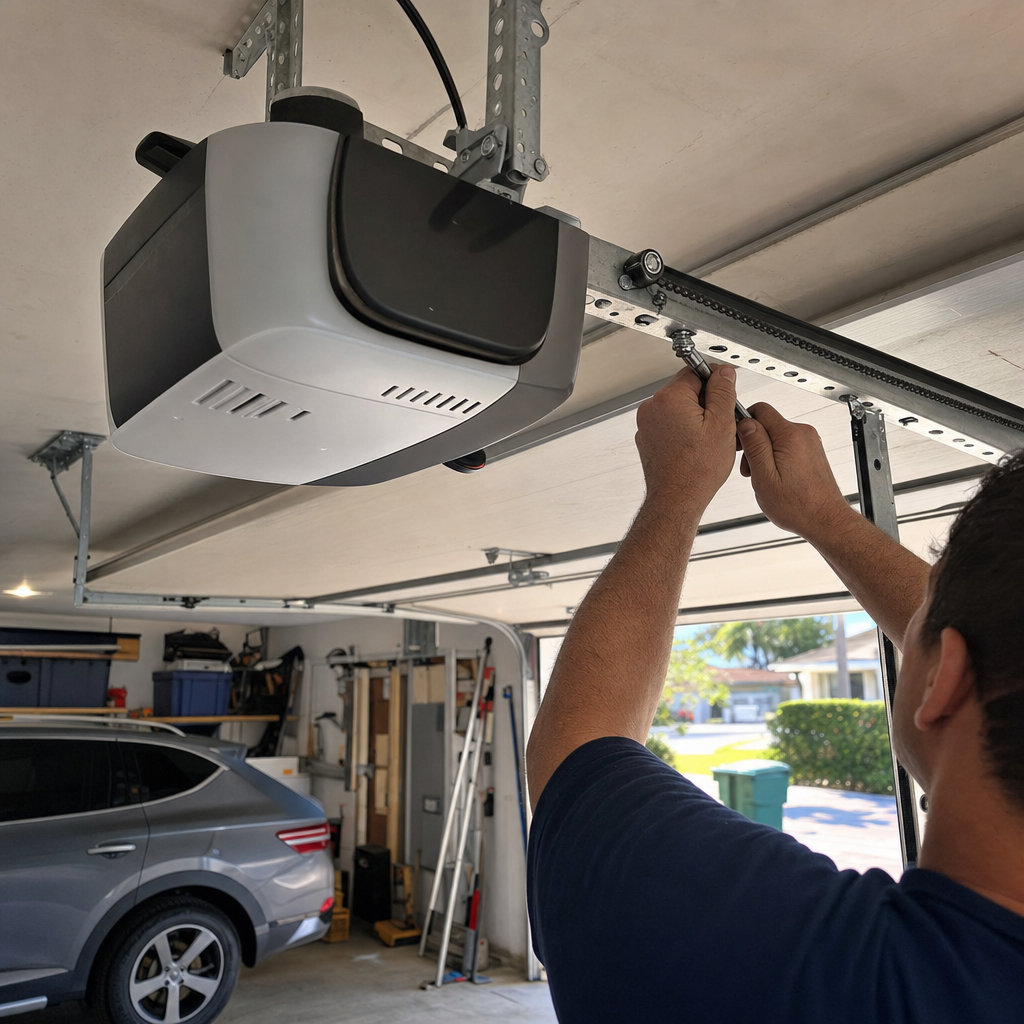
- Lubricate all moving metal parts. Use a silicone-based or lithium-grease spray, not WD-40. Apply to hinges, rollers (not the track itself), torsion spring coils, and the opener’s chain or drive screw. In Miami’s humidity, we recommend doing this at minimum twice a year — dry season is the first application.
- Test the auto-reverse safety feature. Place a 2×4 flat on the ground under the door. When the door contacts it and reverses, the safety is working. If it doesn’t reverse within 2 seconds, the opener needs adjustment.
- Check and replace weather seals. Miami’s UV exposure degrades rubber seals faster than cold-climate doors. Run your hand along the bottom seal and side seals — if they’re brittle, cracked, or flattened, replace them before the rains return in April.
- Inspect panels for damage. Look for dents, warping, or paint bubbling. On steel Clopay or Wayne Dalton doors, paint bubbling often signals the beginning of rust forming underneath the finish.
Dry season is also the ideal time to schedule a professional tune-up if you haven’t had one in the past 12 months. Gary Hill personally handles tune-up appointments across Miami and can catch issues — like a spring that’s lost tension or a cable drum showing wear — that aren’t obvious to the untrained eye.
Spring Transition (April–May): Pre-Hurricane Prep Begins
April and May are Miami’s shoulder months — rain is picking up, humidity is climbing back toward summer levels, and the Atlantic hurricane season officially begins June 1. This is your prep window. A garage door that isn’t hurricane-ready isn’t just a property risk; it can compromise the structural integrity of your entire home. When garage doors fail during a storm, wind pressure can enter the structure and blow out walls or lift the roof.
April–May Checklist
- Verify your door’s wind-load rating. Miami-Dade County has some of the strictest hurricane product approval requirements in the country. If your door was installed before 2002 or you’re not sure of its rating, check the door’s product approval number against the Miami-Dade NOA (Notice of Acceptance) database. Doors without a valid NOA are technically non-compliant and won’t perform as intended in a major storm.
- Check hurricane bracing hardware. Many Miami homes have vertical and horizontal bracing struts on the interior of the door. Inspect these for rust, cracks, or missing bolts. Compromised bracing is one of the most common failures we see after storms in areas like Kendall and Miami Lakes.
- Assess your opener’s battery backup. LiftMaster and Chamberlain openers with battery backup become critical when power goes out before or during a storm. If your backup battery is more than 3 years old, replace it now — not during a tropical storm watch.
- Test manual release operation. Pull the red emergency release cord and confirm the door can be lifted manually. This is how you get out — or secure the door — when the power is out. If the door won’t lift easily by hand, a spring issue may be reducing counterbalance.
- Clear and clean the tracks. Debris accumulation in the track, common after Miami’s spring thunderstorms, can cause misalignment. Wipe tracks clean with a damp cloth; do not lubricate them.
Hurricane Season (June–November): Protect, Inspect, and Reinforce
Miami homeowners have a complicated relationship with hurricane prep — by mid-August, the routine can feel routine. But your garage door deserves fresh attention every season, because it’s the largest opening in your home and one of the most wind-vulnerable components of the structure.
Before a Named Storm: 48-Hour Protocol
- Do NOT lock your garage door with the opener engaged during a storm. The motor mount can fail under wind load, leaving you unable to open the door manually afterward. Lock the door using the door’s manual lock bar or slide bolt instead.
- Disconnect the opener. Pull the emergency release so the opener is decoupled. If the door warps or the tracks shift during the storm, you don’t want the opener trying to force it.
- If you have a non-rated door, consider a hurricane brace kit. These temporary vertical braces, available at local home improvement stores, add significant wind resistance to unrated single-layer doors. They won’t make a non-rated door fully compliant, but they reduce the risk of catastrophic failure.
- After the storm, inspect before operating. Check tracks for debris and bending, look for panel damage, and test the door’s balance manually before re-engaging the opener. Forcing a damaged door with a motor can destroy the opener and worsen panel damage.
Post-storm calls are the busiest period of our year. In our experience, most post-hurricane garage door failures in Miami are either doors that were already weakened by corrosion and deferred maintenance, or doors that were forced with an opener after sustaining track damage. A quick manual check takes 60 seconds and can save you a significant repair bill.
Year-Round Heat Stress: What Miami Summers Do to Openers and Seals
Miami garage interiors regularly hit 110–120°F in summer, especially in west-facing garages in neighborhoods like Doral, Fontainebleau, and West Kendall. That heat affects three things more than most homeowners expect.
Opener Circuit Boards and Motors
LiftMaster, Chamberlain, and Genie openers are rated for high temperatures, but sustained exposure to extreme garage heat shortens their lifespan. If your garage isn’t insulated and your opener is mounted in direct sun exposure through a west-facing window, consider adding attic insulation or a simple reflective barrier. Openers that overheat repeatedly tend to develop intermittent operation issues — the door stops mid-travel or reverses for no apparent reason — which homeowners often misdiagnose as a sensor problem.
Bottom Weather Seals
Rubber bottom seals in Miami age quickly. UV radiation and heat make the rubber brittle within 3–5 years on average, compared to 7–10 years in cooler climates. A cracked bottom seal doesn’t just let in water during heavy rain — it lets in insects, lizards (a very real Miami problem), and conditioned air from your home if the garage is climate-controlled.
Wood and Composite Door Panels
If you have a wood or wood-composite door from Clopay or Amarr, Miami heat combined with humidity creates a cycle of expansion and contraction that can warp panels and crack paint over time. Annual resealing of the top and side edges of wood doors is the single most effective way to extend their life in South Florida.
Salt-Air Corrosion: The Silent Killer of Miami Garage Doors
Salt corrosion is the issue that separates Miami garage door maintenance from every other U.S. market. We’ve seen torsion springs fail in under three years on doors less than a mile from the water in areas like Coconut Grove and South Miami. The same spring on the same door in an inland, low-humidity city might last 8–10 years.
What Corrodes Fastest in Miami
- Torsion and extension springs — high-tension steel with a large surface area; rust weakens the coils and accelerates fatigue failure.
- Bottom brackets and cables — both are under constant tension; a corroded cable frays before it snaps, giving you a warning if you’re looking for it.
- Hinges — especially the stamped-steel hinges on lightweight residential doors from Craftsman or Raynor; these can rust through entirely within a few years near the coast.
- Track hardware and mounting bolts — often overlooked, but loose bolts from corroded anchors are a common cause of misalignment after storms.
Corrosion Prevention Steps
- After each significant rainstorm, wipe down visible hardware with a dry cloth to remove moisture.
- Apply a marine-grade or corrosion-inhibiting lubricant (not standard household oil) to springs, hinges, and cables every 3–4 months if you’re within a mile of salt water.
- Consider galvanized or powder-coated hardware upgrades when springs or cables need replacement — the cost difference is modest and the longevity gain in Miami is substantial.
- Inspect cable ends where they attach to the bottom bracket — this junction collects moisture and corrodes faster than the cable’s main length.
For homes in waterfront neighborhoods — Miami Beach, Coconut Grove, Key Biscayne adjacent areas, and anything east of US-1 in Coral Gables — we recommend checking spring condition every 12 months without exception. Waiting until a spring snaps is a false economy; emergency spring replacement always costs more than a scheduled one.
Your Miami Garage Door DIY Maintenance Checklist
Use this checklist twice a year — once in January (dry season) and once in May (pre-hurricane season). It takes about 20–30 minutes and requires no special tools beyond a step stool, a cloth, and a can of silicone or lithium-grease spray.
Visual & Safety Checks
- Visually inspect all springs, cables, hinges, and rollers for rust, fraying, or cracking
- Check all mounting bolts and track brackets for tightness (hand-tighten only — overtightening strips threads)
- Look at the bottom and side weather seals for brittleness, gaps, or flattening
- Test the auto-reverse safety feature with a 2×4 block
- Test the photo-eye sensors by passing your hand through the beam while the door is closing — it should reverse immediately
- Pull the emergency release cord and lift the door manually — it should move smoothly and stay open at the halfway point (balanced spring system)
Lubrication
- Spray hinges, rollers, and torsion spring coils with silicone or lithium-grease spray
- Lubricate the opener’s drive mechanism (chain, belt, or screw) per the manufacturer’s instructions — Genie and LiftMaster have different requirements
- Do NOT lubricate the tracks — clean them with a damp cloth instead
Hurricane-Readiness Checks (May Only)
- Confirm door’s Miami-Dade product approval (NOA) is on file and door hardware matches original specification
- Inspect interior bracing struts for rust, cracks, or missing fasteners
- Replace opener battery backup if older than 3 years
- Practice disconnecting and manually operating the door
Common Mistakes to Avoid
- Using WD-40 as a garage door lubricant. WD-40 is a solvent and a moisture displacer, not a lasting lubricant. It strips existing grease and leaves metal parts dry within weeks — a significant problem in Miami’s constant humidity. Use silicone spray or white lithium grease instead.
- Ignoring rust on springs because “they still work.” A corroded torsion spring is under 150–200 lbs of tension. When it snaps, it snaps suddenly and violently. In Miami’s salt air, surface rust on a spring is not cosmetic — it’s a countdown. Address it.
- Lubricating the tracks. Greasy tracks attract dirt, gum up rollers, and cause the door to bind or jump the track. Tracks should be clean and dry. Only the rollers that ride inside the track get lubricated.
- Operating the door with the opener during or immediately after a storm. If a storm shifted your tracks even slightly, forcing the door with a motor can bend the track, strip the trolley, and damage the opener’s drive gear in a single cycle. Always check manually first.
- Skipping the weather seal replacement until water is already coming in. By the time you notice water on the garage floor, the seal has usually been failing for one or two rainy seasons. Miami’s afternoon thunderstorms are relentless — a degraded seal lets in significant water volume quickly.
- Assuming a new door doesn’t need maintenance. We regularly service Clopay and Amarr doors that are less than two years old but were installed near the water without any subsequent lubrication or hardware treatment. Miami’s environment doesn’t give new doors a grace period.
- Buying a non-rated door to save money. Miami-Dade’s building code requires wind-load rated doors, and non-rated doors can void homeowner’s insurance claims after storm damage. The Miami Local Garage Door Repair Pros home page has more on code-compliant installation options.
When to Call a Professional
Some garage door tasks are genuinely safe for homeowners — lubrication, sensor alignment, visual inspections, seal replacement. Others are not. Call a professional when you encounter any of the following situations:
- A broken or visibly cracked torsion spring — these are under extreme tension and require specialized tools and training to replace safely
- A fraying or snapped cable — cables work in tandem with springs and the door will be unbalanced and potentially dangerous
- A door that won’t stay open at the halfway point when released manually — this indicates a spring balance problem
- An opener that stops mid-travel, reverses unexpectedly, or won’t respond to remotes — could be a logic board, sensor, or safety issue
- Visible bending or separation in track sections after a storm
- Any post-hurricane damage before attempting to operate the door
Gary Hill’s Garage Door Repair Pros offers free estimates across Miami — and with 16 years of hands-on experience and 654 five-star reviews, Gary handles every job personally. If your door isn’t behaving right, call (786) 808-7839 before a small problem becomes an expensive one.
Frequently Asked Questions
How often should I lubricate my garage door in Miami?
In Miami, lubricate your garage door’s moving parts at least twice a year — once in January and once in May. The combination of high humidity and salt air accelerates corrosion faster than inland U.S. climates, so standard once-a-year advice doesn’t apply here. If you live within a mile of the water in areas like Coconut Grove or Miami Beach, bump that to every three to four months for springs, hinges, and cables. Call (786) 808-7839 if you’re unsure what lubricant is right for your specific door and opener model — the estimate is free.
Is my garage door strong enough for a Miami hurricane?
Only if it carries a valid Miami-Dade Notice of Acceptance (NOA) for wind load. Miami-Dade County enforces some of the strictest hurricane product standards in the country, and a door without a valid NOA is not compliant regardless of how new or sturdy it looks. Check your door’s product approval label (usually on the interior panel or in your permit documentation) and verify it against the Miami-Dade approved products list. If you’re unsure, our team can assess your door’s hurricane compliance during a service visit. Need a compliant replacement? See our Garage Door Installation in Princeton page for installation options.
How long do garage door springs last in Miami compared to other cities?
Garage door torsion springs in Miami typically last 5–7 years, compared to 8–10 years in drier, inland climates. Salt air accelerates metal fatigue significantly, particularly for doors within a mile of Biscayne Bay or the Atlantic coastline. Springs are rated by cycle count (a standard spring is rated for 10,000 cycles), but corrosion can cause failure well before the cycle count is reached. If your springs are over five years old and you haven’t had them inspected, schedule a check before hurricane season starts in June.
Can I replace my own garage door weather seal in Miami?
Yes — bottom door seals and side/top frame seals are among the few garage door components that most homeowners can replace safely. You’ll need the correct seal profile for your door (T-end, bead-end, or bulb, depending on the retainer), a tape measure, and basic tools. In Miami, expect to replace rubber bottom seals every 3–5 years due to UV degradation and heat cycling. If you’re not sure which seal your door uses, bring a photo of the existing seal to any hardware store or call us at (786) 808-7839 for guidance.
What should I do with my garage door before a hurricane in Miami?
Disconnect your opener using the emergency release cord, engage the manual lock bar (not the opener’s lock mechanism), and do not use the opener during the storm. If your door does not have a Miami-Dade rated hurricane brace system, temporary vertical brace kits are available at local home improvement stores and add meaningful wind resistance. After the storm passes, inspect the door manually — checking for track damage, bent panels, and hardware displacement — before re-engaging the opener. Forcing a damaged door with a motor is one of the most common causes of costly post-storm opener damage we see across Miami each season.
How do I know if my garage door opener needs to be replaced versus repaired?
Openers from brands like LiftMaster, Chamberlain, and Genie typically last 10–15 years with proper maintenance. Signs that lean toward replacement rather than repair: the logic board has failed (repair cost approaches 60–70% of a new unit), the opener predates rolling-code technology (a security issue), or you’ve had multiple component failures in a short period. In Miami specifically, openers in hot, humid garages without ventilation tend to age faster. A service visit from Gary Hill includes an honest diagnostic — the right fix, not the fastest upsell. For opener options, see our Garage Door Opener in Princeton page for more context on models we service and install.
The Bottom Line
Miami’s climate demands a maintenance approach that the national guides don’t account for. Salt air corrodes hardware faster than almost anywhere in the continental U.S. Hurricane season runs six months of the year. Summer heat pushes openers and seals to their limits. The homeowners who stay ahead of these conditions — with a dry-season inspection in January and a hurricane prep pass in May — rarely end up with a door failure during the worst possible moment. The ones who skip it tend to call during a storm watch or after a spring snaps on a Monday morning. A little attention twice a year, plus one professional inspection annually, is genuinely all it takes. For any repair or inspection across Miami, call Gary Hill’s Garage Door Repair Pros at (786) 808-7839. Estimates are always free, and Gary handles every job personally. If you need service in Princeton, our Garage Door Repair in Princeton page covers that area in full.
Written by Gary Hill, Owner & Lead Technician at Miami Local Garage Door Repair Pros, serving Miami since 2010.