Last updated June 28, 2026
Garage Door Permits, Codes & Inspections in FL: What You Need to Know
Here’s something most Miami homeowners don’t realize until it’s too late: swapping out a garage door — even a like-for-like replacement — often requires a building permit in Florida. Skip that step, and you could face a failed home sale inspection, a stop-work order, or worse, a door that doesn’t meet Miami-Dade’s hurricane-rated wind-load requirements. Florida’s garage door code environment is among the strictest in the country, and for good reason — the 1992 devastation of Hurricane Andrew exposed how catastrophically under-engineered residential doors were at the time. In this guide, you’ll learn exactly when a permit is required, what the inspection process looks like, and how Miami’s specific codes differ from the rest of the state.
Quick Answer
In Florida, most garage door replacements and all new garage door installations require a building permit, particularly when the work involves structural changes or hurricane-rated door systems. In Miami-Dade County, garage doors must meet a minimum design pressure (DP) rating to comply with the Florida Building Code’s High-Velocity Hurricane Zone (HVHZ) standards — one of the toughest local requirements in the U.S. Skipping the permit process can void your homeowner’s insurance coverage and create serious liability if a door fails during a storm.
Table of Contents
- When Is a Permit Required for a Garage Door in Florida?
- Miami-Dade’s HVHZ Standards: What Makes South Florida Different
- Wind Load & Design Pressure Requirements Explained
- How the Florida Garage Door Permit Process Works (Step by Step)
- What Happens During a Garage Door Inspection?
- NOA Product Approvals: Why the Label on Your Door Matters
- Common Mistakes to Avoid
- When to Call a Professional
When Is a Permit Required for a Garage Door in Florida?
Florida Statute 553 and the Florida Building Code (FBC) govern when permits are required for garage door work. The short answer: if you’re replacing an entire door system or installing a new one, you almost certainly need a permit. Minor repairs — replacing a broken spring, swapping out a roller, or fixing a cable — are generally exempt. But the moment you’re installing a new door panel, a new door system, or a new opener on a commercial property, the permit threshold is crossed.
Here’s a practical breakdown of what typically requires a permit in Florida:
- Full garage door replacement — even if the new door is the same size and style as the old one
- New garage door installation in a new construction or addition
- Widening or narrowing the garage opening — any structural modification to the rough opening
- Converting a garage opening to another use (e.g., enclosing it)
- Installing a garage door where none previously existed
What generally does not require a permit:
- Spring replacement (torsion or extension)
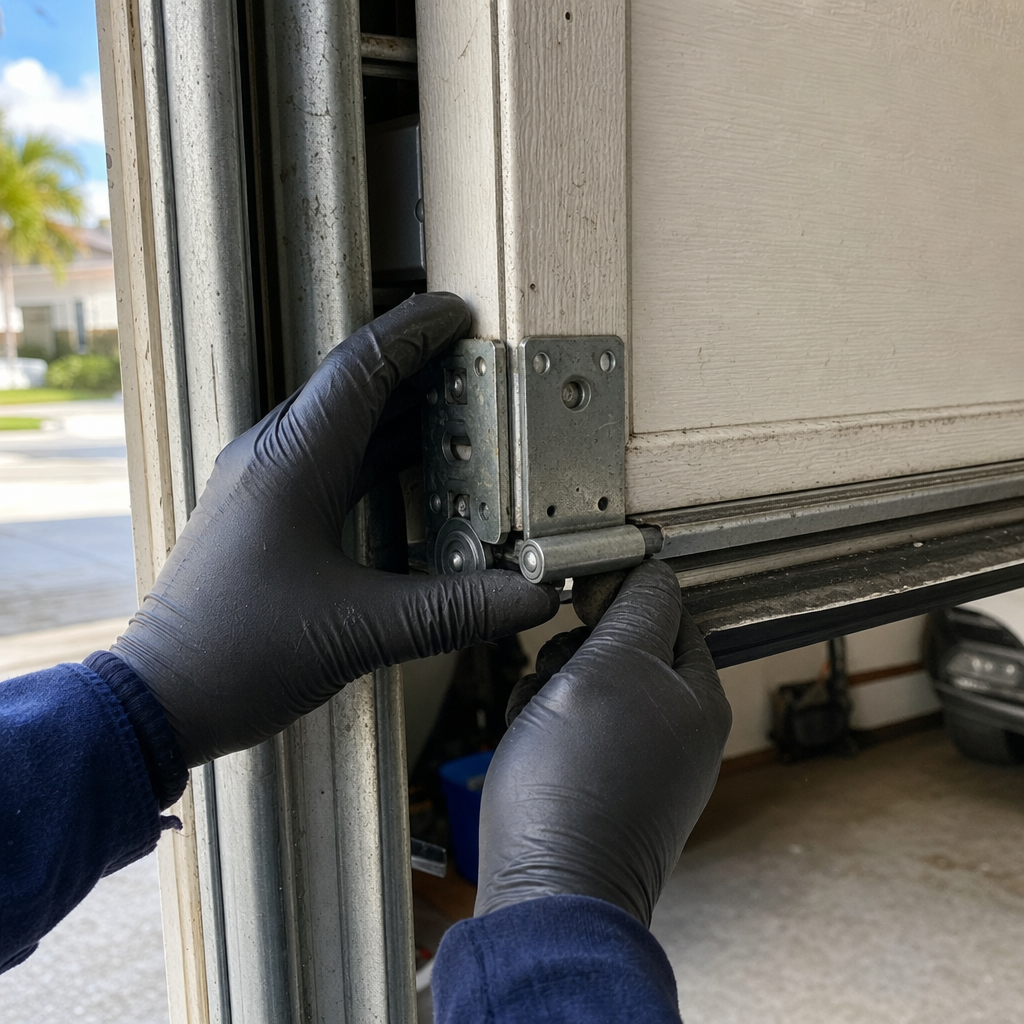
- Cable, roller, or hinge replacement
- Residential garage door opener replacement (in most jurisdictions — always confirm locally)
- Weatherstripping replacement
Keep in mind that local municipalities can add requirements on top of the state baseline. In Miami, the Building Department enforces permit requirements strictly, and inspectors do check on work in progress. If your neighbor reports unpermitted work — or a city inspector drives by and sees a new door going up — you can receive a stop-work order even after installation is complete.
Miami-Dade’s HVHZ Standards: What Makes South Florida Different
Miami-Dade and Broward counties sit within what the Florida Building Code designates as the High-Velocity Hurricane Zone (HVHZ). This isn’t a marketing label — it’s a legal classification that triggers a separate, more demanding section of the FBC (Chapter 44 for roofing, and product approval requirements that extend to garage doors). No other region in the continental United States has residential construction requirements this stringent.
The HVHZ designation exists because of wind speeds: Miami’s design wind speed for residential structures is 175 mph at a 3-second gust in many areas. A standard garage door sold and installed legally in Orlando would not be code-compliant in Miami without additional engineering documentation.
What this means practically for Miami homeowners:
- Every garage door installed in Miami-Dade must have a valid Notice of Acceptance (NOA) issued by the Miami-Dade County Product Control Section.
- The NOA must be specific to the door model, size, and configuration — not just the brand.
- Doors that are even slightly modified from their tested configuration (e.g., an extra window cutout not listed in the NOA) may require re-testing or a separate engineer’s letter.
- Installers are required to use the exact hardware — hinges, tracks, brackets, struts — specified in the NOA. Substituting a “similar” bracket is a code violation.
In our 16 years serving Miami, Gary Hill and the team at Miami Local Garage Door Repair Pros have seen homeowners come to us after purchasing doors online — beautiful Clopay or Amarr doors with legitimate specs — only to discover those specific models didn’t carry a Miami-Dade NOA. The door has to be sent back, and the homeowner loses weeks of lead time. Buying locally from a contractor who knows the HVHZ requirement isn’t just convenience; it’s risk management.
Wind Load & Design Pressure Requirements Explained
Design pressure (DP) is the measure of a garage door’s ability to withstand both positive pressure (wind pushing in) and negative pressure (suction pulling out). Florida’s Building Code specifies minimum DP ratings based on your home’s location, height, and exposure category.
For most single-family homes in Miami, you’re looking at minimum design pressure values in the range of +40 psf / -45 psf, though corner lots, elevated homes, and properties near open water can require significantly higher ratings. Your contractor calculates this using the FBC’s wind load tables — it’s not a guess.
Here’s how DP ratings translate to door specifications:
- Standard residential doors (non-HVHZ): often rated DP 20–30, adequate for Central and North Florida
- HVHZ-compliant doors: minimum DP 40+, with most Miami installations running DP 50–70 depending on opening size and exposure
- Larger openings require higher-rated doors: a 16-foot wide door needs more reinforcement (typically heavier-gauge steel and additional horizontal struts) than an 8-foot door to achieve the same DP rating
- Door height matters too: taller doors are more susceptible to racking and require more horizontal bracing
Wayne Dalton, Clopay, Amarr, and Raynor all manufacture HVHZ-rated product lines specifically tested and approved for Miami-Dade. LiftMaster and Genie produce openers with battery backup and UL 325 compliance — critical features given Miami’s frequent power outages after storms. When we spec a door for a Miami home, the DP calculation comes first; aesthetics come second.
How the Florida Garage Door Permit Process Works (Step by Step)
The permit process in Miami-Dade is manageable when you know the steps. Licensed contractors typically handle the entire process on your behalf — which is one reason hiring a licensed local installer rather than a general handyman matters here. Below is the standard process as it applies in Miami.
- Determine the scope of work. Is this a full replacement, structural modification, or new installation? This determines whether a permit is required and which permit type applies (mechanical, building, or structural).
- Select a code-compliant door with a valid NOA. Your contractor should verify the NOA number before ordering the door. Miami-Dade’s Product Control database is searchable online at miamidade.gov/building. The NOA must be current — they expire and require renewal.
- Submit the permit application. In Miami, this is done through the Miami-Dade Building Department’s ePlan system. The application requires the door’s NOA number, product specifications, and the address of the installation. Your contractor’s license number is also required on the application.
- Pay the permit fee. Garage door permit fees in Miami-Dade typically range from $90 to $250 for a standard residential replacement, depending on the project valuation. Fees are set by the county and updated periodically.
- Receive permit approval. Standard residential garage door permits are often approved within 3 to 10 business days for straightforward replacements. Structural modifications or commercial projects may require plan review, adding time.
- Post the permit. The physical permit must be posted visibly at the job site during installation. Inspectors will look for it.
- Schedule and pass the inspection. After installation, your contractor requests an inspection through the Building Department. An inspector visits to verify the door was installed per the approved NOA, using the correct hardware and configuration.
- Receive your Certificate of Completion (CC). Once the inspection passes, the permit is closed and a CC is issued. Keep this document — you’ll need it if you ever sell the home or file an insurance claim related to the door.
What Happens During a Garage Door Inspection?
A garage door inspection in Miami is more thorough than many homeowners expect. The inspector isn’t just eyeballing the door — they’re verifying compliance with the specific NOA that was submitted with the permit. Here’s what they’re typically checking:
- NOA label: Every Miami-Dade approved door ships with a permanent label affixed to the door or frame listing the NOA number, tested DP rating, and approved installation configuration. The inspector verifies this label is present and matches the permit application.
- Hardware compliance: Hinges, rollers, tracks, brackets, and struts must match exactly what’s listed in the NOA installation instructions. Using off-brand hardware — even if it looks identical — is a citation.
- Anchorage to structure: The track brackets must be anchored to the structural framing of the garage, not just drywall or trim. The inspector checks fastener type, size, and spacing against the NOA requirements.
- Opener compliance: If an opener was installed as part of the permitted work, the inspector may verify it’s a UL 325-listed unit and that the automatic reversal mechanism functions correctly — a federal safety requirement.
- Weather seals and perimeter gap: The inspector checks that the perimeter seal properly closes the gap around the door, which affects both weather resistance and wind pressure performance.
Failed inspections are more common than contractors like to admit. In our experience, the most frequent citation involves hardware substitution — a well-meaning installer uses the “equivalent” bracket from their truck stock rather than the specified one. It’s a small thing that creates a re-inspection and a delay. Gary Hill carries NOA-matched hardware for every brand and model we install, specifically to avoid this.
NOA Product Approvals: Why the Label on Your Door Matters
The Notice of Acceptance (NOA) is Miami-Dade County’s own product approval system — separate from and in addition to the Florida Building Code’s statewide approval process. It exists because the HVHZ requires testing standards that exceed state minimums, and Miami-Dade runs its own Product Control Section to administer them.
Here’s what you need to know about NOAs in plain terms:
- An NOA is model-specific, not brand-wide. Clopay having some NOA-approved doors doesn’t mean every Clopay door in their catalog is approved for Miami. You need to verify the exact model number.
- NOAs expire. They’re issued for a set period and must be renewed. An installer using a product with an expired NOA is putting you at risk — and the permit will fail review.
- Size limits are baked in. An NOA approval for a door up to 16 feet wide and 7 feet tall doesn’t automatically cover an 18-foot wide door of the same model. The door has to be re-tested or separately certified for larger sizes.
- Custom configurations require documentation. Want a specific window layout? A non-standard color panel? If those specs weren’t part of the tested configuration, you may need a supplemental engineer’s letter.
- You can look them up yourself. Miami-Dade’s Product Control database lets homeowners search by manufacturer and product type at no cost. It’s worth a five-minute check before you commit to a door purchase.
Brands like LiftMaster, Wayne Dalton, Chamberlain, and Raynor maintain active NOA portfolios for their HVHZ-rated product lines. When we spec a door for a Princeton installation or anywhere else in our Miami service area, confirming the active NOA is step one — not an afterthought.
Common Mistakes to Avoid
- Assuming a repair doesn’t need a permit when it actually does. Replacing an entire door section — not just a panel dent touch-up — often crosses into replacement territory under Florida code. When in doubt, call your local Building Department before starting work, not after.
- Purchasing a door online without verifying its Miami-Dade NOA. A beautiful Amarr or Wayne Dalton door with strong specs may still lack a valid NOA for the HVHZ. An unlabeled door discovered during inspection means removal and re-installation at your expense.
- Letting an unlicensed handyman pull the permit “under the contractor’s license.” In Florida, only the licensed contractor whose name is on the license can legally use it on a permit. Permit-shopping arrangements expose the homeowner to full liability if something goes wrong.
- Not keeping the Certificate of Completion. South Florida real estate transactions increasingly involve insurance underwriters and buyers’ attorneys who request proof of permitted work. A missing CC can delay or kill a home sale in Miami’s competitive market.
- Using hardware from a previous door installation. Reusing old track brackets, hinges, or struts from a prior door system to save money is a common code violation. The NOA specifies hardware as a tested assembly — mix and match is not permitted.
- Skipping the permit to speed up the timeline. Inspectors in Miami do make unsolicited site visits when new doors are visible from the street. An unpermitted installation discovered after the fact requires a retroactive permit, a corrective inspection, and sometimes removal of the door.
- Assuming an opener swap is always permit-free. Residential opener replacement is generally exempt from permits in most Florida jurisdictions, but commercial opener replacements or opener installations tied to a new door installation may require inclusion in the door permit. Confirm with your jurisdiction before assuming.
When to Call a Professional
Any time a permit is involved, you want a licensed contractor managing the process — not because the paperwork is impossible, but because the liability falls on whoever pulls the permit. If an unlicensed installer pulls a permit improperly and the door fails during a storm, your insurance carrier will investigate the installation record. That’s not a risk worth taking in Miami hurricane country.
Call a professional for: full door replacements, any structural modification to the garage opening, new construction installs, and any situation where you’re uncertain whether a permit is required. Also call when you’re comparing doors and need someone who can read an NOA specification sheet, calculate the correct DP rating for your home’s exposure category, and order the right hardware assembly — not approximate it.
Miami Local Garage Door Repair Pros offers free estimates in Miami and surrounding communities — call (786) 808-7839 to talk through your project with Gary Hill directly.
Frequently Asked Questions
Yes, in almost every case a full garage door replacement in Miami requires a building permit. The Miami-Dade Building Department requires permits for all door replacements that involve installing a new door system, and the door must carry a valid Miami-Dade Notice of Acceptance (NOA) for the High-Velocity Hurricane Zone. Call (786) 808-7839 if you’d like us to confirm what your specific project requires — the consultation is free.
Garage door permit fees in Miami-Dade County typically fall in the range of $90 to $250 for a standard single-family residential replacement, based on the project’s declared value. More complex projects — those involving structural opening modifications or commercial properties — carry higher fees calculated against the total project valuation. Your contractor will calculate and collect this fee as part of the permitting process.
An NOA (Notice of Acceptance) is Miami-Dade County’s product approval certification — it confirms that a specific door model has been independently tested to withstand the wind pressures of the High-Velocity Hurricane Zone. Without a valid NOA, a garage door cannot legally be installed in Miami-Dade or Broward counties, and the permit application will be rejected. Every major brand we work with — Clopay, Amarr, Wayne Dalton, LiftMaster, Raynor — maintains NOA-certified product lines; the key is verifying the specific model number before purchase.
Skipping a required permit in Florida can result in a stop-work order, forced removal of the unpermitted door, retroactive permit fees, and potential fines from the local Building Department. More consequentially, an unpermitted door can void wind-storm coverage under your homeowner’s insurance policy — a serious exposure in Miami — and can delay or prevent the sale of your home when a title search or buyer inspection uncovers the missing permit record.
Residential garage door opener replacement on its own is generally exempt from permit requirements in most Florida jurisdictions, including Miami-Dade, as long as the opener swap is a standalone repair and not part of a full door replacement. However, if the opener installation is included as part of a permitted door replacement project, it should be listed on the permit application. When in doubt, ask your Building Department or call us — it’s a quick question that can save you a headache later.
Standard residential garage door replacement permits in Miami-Dade are typically approved within 3 to 10 business days when the application is complete and the NOA information is correct. Projects that require structural plan review — such as modifications to the rough opening size — can take several weeks. Submitting through the Miami-Dade ePlan system with a complete application, correct NOA documentation, and an accurate project valuation helps avoid revision requests that add to the timeline.
The Bottom Line
Florida’s garage door code requirements are detailed, and Miami’s HVHZ rules add another layer that catches a lot of homeowners off guard. The core takeaways: permits are required for replacements, not just new construction; Miami-Dade’s NOA requirement is non-negotiable and model-specific; and hardware compliance during installation is where inspections most often fail. Cutting corners on any of these steps creates real financial and safety exposure — particularly in a market where a named storm can arrive with 48 hours’ notice. Work with a licensed contractor who knows Miami’s specific requirements from the ground up, and keep your Certificate of Completion once the job is done.
If you have questions about a specific project — or you’re trying to figure out whether your current door is code-compliant — Gary Hill is happy to take a look. After 16 years and 654 five-star reviews in the Miami market, there aren’t many garage door code questions we haven’t answered. Call (786) 808-7839 for a free estimate or a straight answer.
For more of our work across South Florida, visit the Miami Local Garage Door Repair Pros home page, or explore specific services like Garage Door Repair in Princeton, Garage Door Installation in Princeton, and Garage Door Opener in Princeton.
Written by Gary Hill, Owner & Lead Technician at Miami Local Garage Door Repair Pros, serving Miami since 2010.