Last updated June 28, 2026
Garage Door Repair Maintenance Checklist for Miami Homeowners
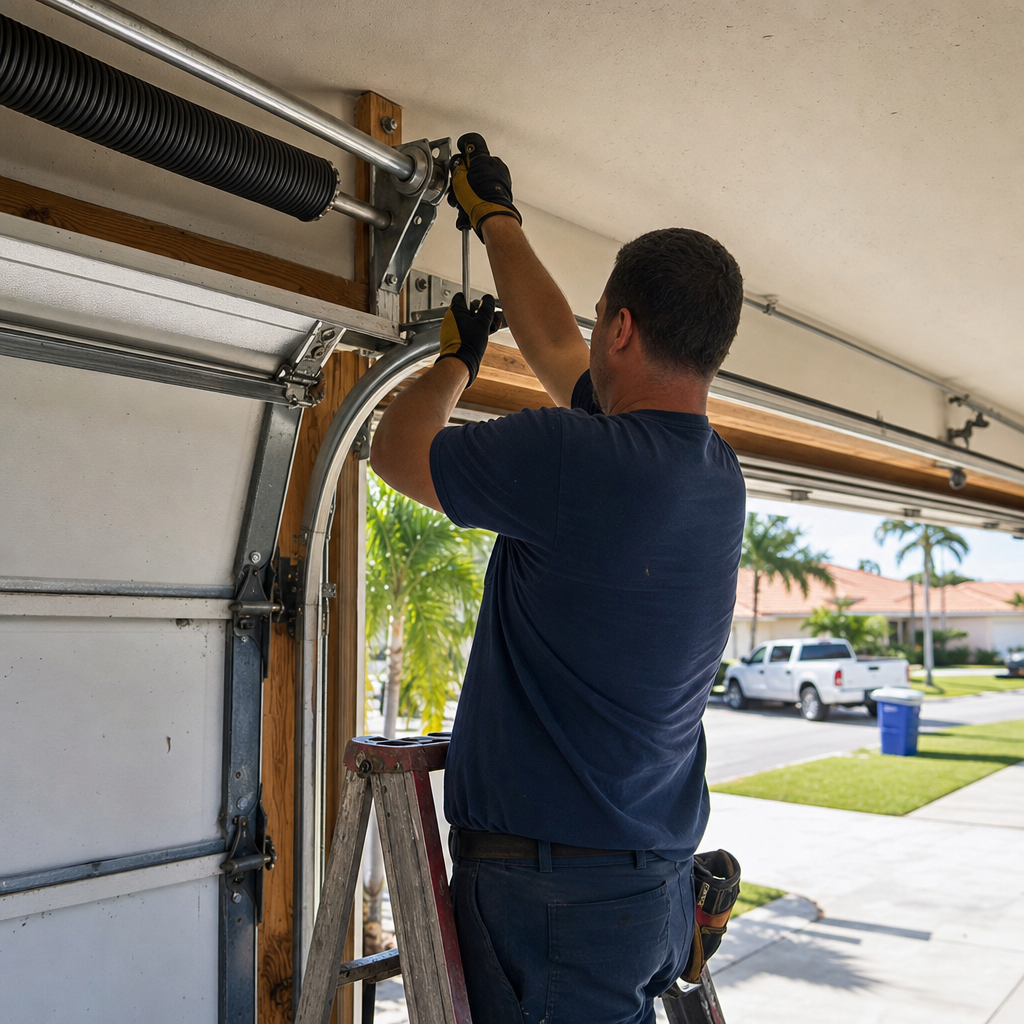
Here’s something most Miami homeowners don’t realize: the biggest threat to your garage door isn’t a broken spring or a dead opener battery — it’s salt air. Miami’s coastal humidity and salt-laden wind accelerate corrosion on hinges, springs, and tracks at a rate that’s two to three times faster than what homeowners experience in dry inland climates. We’ve pulled springs in Coconut Grove and Brickell that looked perfectly intact on the surface but had corroded to the point of near-failure on the inside coil. This guide gives you a practical, Miami-specific maintenance checklist so you can stay ahead of the repairs that local conditions make inevitable — and spot the ones that need professional attention before they leave you stuck in your driveway.
Quick Answer
A complete garage door maintenance checklist for Miami homeowners covers monthly visual inspections, quarterly lubrication with a salt-resistant lubricant, annual spring and cable tension checks, and seasonal weatherstripping replacements to handle South Florida’s wet and dry cycles. Miami’s humidity and salt air mean you’ll need to maintain your door roughly twice as often as homeowners in drier climates — skipping even one maintenance cycle can turn a $15 lubrication job into a $250 spring replacement.
Table of Contents
- 1. Monthly Visual Inspection Checklist
- 2. How and When to Lubricate Your Garage Door in Miami
- 3. Springs, Cables, and Tension: What to Check and What to Leave Alone
- 4. Weatherstripping and Seals: Miami’s Wet Season Makes These Critical
- 5. Garage Door Opener Maintenance
- 6. Hurricane Season Readiness for Your Garage Door
- 7. Annual Professional Tune-Up: What It Includes and Why It’s Worth It
- Common Mistakes to Avoid
- When to Call a Professional
- Frequently Asked Questions
- The Bottom Line
1. Monthly Visual Inspection Checklist
A five-minute walk-through every month catches small problems before they compound. In Miami, where temperature swings between dry season (November–April) and wet season (May–October) stress every mechanical component on your door, the monthly check is not optional — it’s the difference between a $0 fix and a $400 repair call.
Stand inside your garage with the door closed and work from the top down:
- Check the springs above the door. Look for visible rust, gaps in the coil, or any section of the spring that looks stretched thinner than the rest. A gap or uneven coil means the spring is approaching failure.
- Inspect the cables on both sides. They should be taut, evenly tensioned, and free of fraying. Frayed cable strands in Miami often mean moisture has gotten into the cable core.
- Look at the rollers. Nylon rollers should roll smoothly in the track without wobble. Steel rollers should show no rust pitting on the wheel surface.
- Examine the tracks. No bends, no gaps at the brackets, and no buildup of grit or debris at the bottom curve where the vertical track meets the horizontal.
- Test the door balance. Disconnect the opener (pull the red emergency cord), lift the door manually to about waist height, and let go. It should stay put — not fall down or rise up. If it moves more than a few inches either way, the spring tension is off.
- Check the bottom seal. Press your hand along the bottom of the closed door from the inside. You shouldn’t feel outside air moving in, especially during Miami’s afternoon thunderstorms.
Write the date and any notes in your phone. If the same item shows up two months in a row, that’s your cue to act.
2. How and When to Lubricate Your Garage Door in Miami
In Miami, standard white lithium grease is not enough. You need a lubricant with corrosion inhibitors — either a marine-grade white lithium spray or a silicone-based spray with rust-inhibiting additives. WD-40 is not a lubricant; it’s a solvent that will dry out your components and leave them more vulnerable to the salt air than before you started. We’ve seen this mistake on doors from Hialeah to Kendall.
Lubricate on this schedule in Miami:
- Every 3 months: Springs (top of each coil), hinges (the pivot points only, not the flat plates), rollers (the stem where it inserts into the hinge, not the wheel itself if it’s a nylon roller), and the lock bar if your door has one.
- Every 6 months: The full length of the tracks — a light wipe, not a heavy application. Heavy grease in tracks attracts the South Florida dust and debris that blows in during dry season.
- Annually: The bearing plates at each end of the spring shaft, and the pulley wheels on the cable drums.
Apply lubricant, then run the door up and down three times to distribute it evenly. Wipe off any drips immediately — excess lubricant on the door panels of a painted Clopay or Amarr door can stain the finish over time.
What not to lubricate: The bottom rubber seal, the weatherstripping on the sides, and the track interior surface. These don’t need lubricant — grease on them actually degrades the rubber and attracts debris.
3. Springs, Cables, and Tension: What to Check and What to Leave Alone
Springs and cables are under enormous stored tension — enough to cause serious injury if released improperly. This section tells you what you can safely observe and what you should never touch without professional tools and training.
What you can safely check yourself:
- Visual inspection for rust, gaps, or uneven coil spacing on torsion springs (the horizontal spring above the door) or extension springs (the springs that run parallel to the horizontal tracks on either side).
- Cable inspection for fraying, kinking, or a cable that has slipped off its drum.
- The balance test described in Section 1 — that tells you a lot about overall spring health without touching the spring itself.
What to leave to a professional:
- Adjusting spring tension in any way.
- Replacing a broken torsion or extension spring.
- Re-threading or replacing a cable.
- Adjusting the cable drum set screws.
In Miami, we recommend having springs professionally inspected once a year regardless of how they look. The interior coil surface corrodes from the inside out in high-humidity environments — a spring can look fine and still be six weeks from snapping. After 16 years working on garage doors across Miami-Dade County, Gary Hill has seen this scenario play out in neighborhoods from Palmetto Bay to North Miami Beach more times than he can count.
4. Weatherstripping and Seals: Miami’s Wet Season Makes These Critical
Miami gets an average of 61 inches of rain per year, most of it falling in intense afternoon bursts between June and October. A failed bottom seal or cracked side weatherstrip isn’t just a minor annoyance — it’s a direct path for water intrusion into your garage, which can damage flooring, stored belongings, and the door’s bottom panel if it’s wood or composite.
There are four sealing points on a standard garage door:
- Bottom seal (astragal): The rubber or vinyl bulb seal that runs across the bottom of the door. In Miami, UV degradation causes these to crack and flatten faster than in cooler climates. Replace when you see cracking, missing sections, or daylight visible under the door from inside.
- Side weatherstripping: The vinyl or rubber strips nailed or screwed to the door jamb on both sides. Check for compression loss — if the strip is no longer pressing firmly against the door panel, air and water are getting through.
- Top seal: The strip that seals the gap between the top of the door and the header. Often overlooked, but critical during horizontal rain driven by Miami’s afternoon storms.
- Floor threshold seal: An optional but highly recommended addition in Miami — a raised rubber threshold glued to the concrete that creates a secondary barrier against water and pests. Homes in low-lying areas like parts of Westchester and Flagami benefit especially from these.
Replace weatherstripping at the first sign of cracking — don’t wait until a rainstorm makes the problem obvious. A new bottom seal runs about $25–$60 in materials and takes under an hour to swap out yourself if the door is a standard single-car width.
5. Garage Door Opener Maintenance
Your opener does its job invisibly until it doesn’t. Miami’s humidity is hard on the electronics inside opener units, and the constant thermal expansion and contraction from summer heat affects the drive mechanism over time. Whether you’re running a LiftMaster belt drive, a Chamberlain chain drive, a Genie screw drive, or a Craftsman DC motor unit, the maintenance steps are consistent.
Every 6 months:
- Test the auto-reverse feature: place a 2×4 flat on the ground in the door’s path and hit the close button. The door should reverse immediately upon contact. If it doesn’t, adjust the sensitivity settings or call for service — this is a safety requirement, not a preference.
- Test the photo-eye sensors: wave your hand through the beam while the door is closing. The door should reverse. Clean the sensor lenses with a dry cloth — Miami dust and humidity cause lens fogging that triggers false reversals.
- Check the drive mechanism: on a chain drive, look for chain sag (more than half an inch of droop at the midpoint means it needs tightening). On a belt drive, check for fraying at the edges. On a screw drive, a light application of the manufacturer’s recommended lubricant on the screw rod every 6 months is sufficient.
- Test your battery backup: LiftMaster and Chamberlain units with battery backup are especially popular in Miami because power outages during hurricane season are common. Press the backup test button if your unit has one.
Every 12 months:
- Replace the keypad batteries (even if it’s still working — dead keypad mid-storm is avoidable).
- Inspect the wiring connections between the wall button, sensors, and motor unit for corrosion on the terminal contacts.
- Check the trolley carriage for wear on the drive gear teeth if your unit uses a gear-driven trolley.
6. Hurricane Season Readiness for Your Garage Door
The garage door is the largest opening in most Miami homes, and it’s frequently the first point of failure during a hurricane. Miami-Dade County enforces specific wind-load requirements for garage doors under the Florida Building Code — any door installed after Miami-Dade’s 2002 post-Andrew code revisions must meet a minimum wind-resistance rating. If your door predates that era and hasn’t been replaced, its structural integrity in a major storm is genuinely uncertain.
Here’s the pre-season checklist (run this every May, before the June 1 season start):
- Verify your door’s wind rating. Look for a Miami-Dade NOA (Notice of Acceptance) sticker on the inside of the door. Wayne Dalton, Clopay, and Amarr all make Miami-Dade approved hurricane doors — if your door is one of these brands and was installed post-2002, you’re likely compliant. If there’s no NOA sticker, have it evaluated.
- Inspect all horizontal and vertical reinforcement struts. Hurricane-rated doors typically have steel struts running across each panel. Check that all strut bolts and brackets are tight and rust-free.
- Check the track-to-wall brackets. These carry the lateral load during high winds. Any bracket that’s pulled away from the wall framing even slightly needs to be re-secured before storm season — not during it.
- Test your manual disconnect. If power fails, you need to be able to open and close the door manually without a struggle. Pull the emergency cord and try it. The door should move smoothly. If it’s stiff or heavy, that’s a spring tension or lubrication problem that needs fixing now.
- Install a door barricade kit if your door isn’t hurricane-rated. These bolt-on vertical bracing systems are a temporary measure, not a permanent replacement, but they provide meaningful reinforcement for a non-rated door in a pinch.
Miami-Dade County does not require a permit to replace weatherstripping or perform routine maintenance, but installing a new garage door — or adding structural reinforcements — does require a permit and inspection. Gary Hill is familiar with local permit requirements and handles that process as part of any new door installation through Miami Local Garage Door Repair Pros home.
7. Annual Professional Tune-Up: What It Includes and Why It’s Worth It
There’s a point in every maintenance task where DIY observation meets the limits of what you can safely do yourself. An annual professional tune-up bridges that gap — and in Miami’s climate, it pays for itself in extended component life within a year or two.
A proper professional tune-up on a residential garage door in Miami should cover:
- Full spring inspection with tension measurement — not just visual, but using a winding bar to verify that torsion spring tension is calibrated to the door’s exact weight.
- Cable inspection and re-seating if either cable has shifted on its drum.
- Roller replacement if nylon rollers show flat spots or if steel rollers show rust pitting — most rollers have a rated cycle life and should be replaced proactively.
- Track alignment check and adjustment — tracks in Miami garages can shift as the concrete slab expands and contracts seasonally.
- Opener force and limit setting verification — these drift over time and cause the door to not fully open, not fully close, or not reverse properly.
- Full lubrication of all moving components with corrosion-inhibiting lubricant.
- Hardware tightening — every bolt, lag screw, and bracket connection on the door and track assembly.
- Safety reverse test and photo-eye alignment check.
In our experience serving Miami homeowners for 16 years, the single most common finding on a first-time tune-up is a door that’s out of balance by more than five pounds — which means the opener has been compensating with excess motor strain, shortening its lifespan by years. Catching that at a tune-up is meaningfully cheaper than replacing the opener.
Common Mistakes to Avoid
- Using WD-40 as a lubricant on springs and hinges. WD-40 displaces moisture temporarily but leaves no lasting lubrication film — in Miami’s salt air, components treated with WD-40 often corrode faster than untreated ones within a few months.
- Ignoring a door that’s “just a little slow.” A sluggish door in Miami is almost always a friction or tension issue that will accelerate component wear. By the time it stops moving entirely, the opener’s motor or gear assembly may already be damaged.
- Skipping hurricane prep because “we didn’t get a direct hit last year.” South Florida’s storm track is unpredictable. Miami-Dade’s building code exists because of Andrew — homeowners who defer hurricane-readiness work are gambling with the most vulnerable opening on their house.
- Attempting to replace a torsion spring without professional tools. A torsion spring under full tension stores enough energy to cause a serious crush or laceration injury. This is not a DIY job, even for experienced home repair enthusiasts.
- Painting over rust on the door panels without treating the surface first. In Miami’s humidity, painting over rust without a rust-converting primer just traps moisture underneath and accelerates the corrosion. Sand to bare metal, apply a rust converter, then prime and paint.
- Leaving the bottom seal in place until it completely fails. A cracked or compressed bottom seal in Miami during wet season can let in enough water during a single afternoon storm to warp the bottom panel of a wood or composite door — a repair that costs far more than a $30 seal replacement.
- Assuming a new opener fixes a noisy or rough door. The opener is almost never the source of a mechanical noise. Grinding, banging, and scraping come from the door’s moving parts — springs, rollers, hinges, and tracks. Installing a new Genie or Craftsman opener on a mechanically worn door just means the new opener works harder on a broken system.
When to Call a Professional
Call a professional immediately if you see a broken torsion spring (a visible gap in the coil above the door), a frayed or snapped cable, a panel that has separated from the door frame, or an opener that hums but won’t move the door. These aren’t situations to defer or troubleshoot with YouTube — they involve components under significant mechanical tension or electrical load.
Call for a professional inspection — not an emergency, but soon — if your door fails the balance test, if you hear grinding or scraping during operation, if the door reverses unexpectedly without obstruction, or if you notice rust on springs, cables, or the bottom of the door panels.
Miami Local Garage Door Repair Pros offers free estimates in Miami on any repair or inspection — call (786) 808-7839 and Gary Hill will give you a straight answer on what needs to be done, not a list of upsells. If you’re outside the core Miami area, we also serve nearby communities — you can find local service at our Garage Door Repair in Princeton page.
Frequently Asked Questions
How often should I lubricate my garage door in Miami?
In Miami, lubricate springs, hinges, and rollers every three months — twice as often as the standard recommendation for dry climates. South Florida’s salt air and year-round humidity accelerate corrosion on bare metal components, and a quarterly lubrication schedule with a marine-grade or silicone-based spray is the single most cost-effective maintenance step a Miami homeowner can take. Call (786) 808-7839 if you’d like a professional lubrication service included with a full tune-up.
How much does a garage door tune-up cost in Miami?
A professional garage door tune-up in Miami typically runs between $75 and $150 for a standard residential door, depending on the door size and the condition of the components. That price generally includes a full inspection, lubrication, hardware tightening, and a safety test — it does not include replacement parts if worn components are found during the inspection. Gary Hill will give you an upfront quote before any work begins. Call (786) 808-7839 for a free estimate.
Can I replace my own garage door weatherstripping in Miami?
Yes — replacing the bottom seal or side weatherstripping is one of the few garage door maintenance tasks that’s genuinely DIY-friendly. You’ll need to measure the width of your door, match the seal profile (T-end, T-astragal, or beaded), and buy a replacement at any South Florida hardware store. The job takes 30–45 minutes for a single-car door. If the door jamb itself has rotted from water infiltration, that’s a separate repair that warrants a professional look.
Does Miami-Dade County require a permit to replace a garage door?
Yes — replacing a garage door in Miami-Dade County requires a permit and a final inspection under the Florida Building Code, which enforces wind-load and impact-resistance requirements specific to South Florida. The replacement door must carry a valid Miami-Dade Notice of Acceptance (NOA). Routine maintenance tasks like lubrication, weatherstripping, spring replacement, or opener repair do not require a permit. Gary Hill handles the permit process on all new door installations — if you need a new door installed correctly and to code, visit our Garage Door Installation in Princeton page for an example of our full-service approach, or call us directly for Miami installations.
How do I know if my garage door is hurricane-rated in Miami?
Look for a Miami-Dade County NOA sticker on the inside face of the door — typically on the top panel near the track. The sticker will list the product approval number and the wind-load rating. Brands like Clopay, Amarr, Wayne Dalton, and Raynor all manufacture Miami-Dade approved hurricane-rated doors. If there’s no sticker and you don’t have the original installation paperwork, have the door evaluated before June 1 — the start of hurricane season. Call (786) 808-7839 for a pre-season inspection.
My garage door opener remote stopped working — is it the remote or the opener?
Start with the simplest explanation: replace the batteries first. If new batteries don’t fix it, stand within six feet of the opener motor unit and try the remote — a very short effective range usually means the remote’s signal antenna is weak or the antenna wire on the motor unit has come loose. If the wall button works but the remote doesn’t, the issue is almost always the remote or its antenna, not the motor. If neither the remote nor the wall button moves the door, the motor itself may need service. LiftMaster, Chamberlain, and Genie all have model-specific diagnostics — if you need remote or opener repair, our Garage Door Opener in Princeton page shows the kind of opener work we handle, and we bring the same expertise to every Miami job. Call (786) 808-7839 for a same-day diagnosis.
The Bottom Line
A well-maintained garage door in Miami lasts significantly longer than a neglected one — and the difference comes down to a few consistent habits: quarterly lubrication with the right product, monthly visual checks, annual spring and cable inspections by a professional, and weatherstripping replaced before it fails rather than after. Miami’s climate is genuinely harder on garage doors than most of the country. Salt air, standing humidity, UV exposure, and hurricane season create a maintenance environment that rewards consistency and punishes deferred care. Keep this checklist somewhere you’ll actually use it. The five minutes it takes each month is the cheapest garage door repair you’ll ever do.
Key Takeaways:
- Lubricate springs, hinges, and rollers every 3 months with a corrosion-inhibiting spray — not WD-40.
- Test door balance monthly — a door that falls or rises when released needs professional spring adjustment.
- Replace weatherstripping at the first sign of cracking, especially before wet season.
- Run a hurricane-readiness check every May: verify NOA rating, inspect struts and brackets, test manual disconnect.
- Schedule an annual professional tune-up — spring tension and cable wear are not safely assessed by hand.
- For urgent repairs, broken springs, or a door that won’t move, call before the problem compounds.
Ready for a professional eye on your door? Gary Hill handles every inspection personally — 16 years, 654 five-star reviews, and a direct answer on what your door actually needs. Call (786) 808-7839 for a free estimate. No dispatch center, no subcontractors — just Gary at your door.
Written by Gary Hill, Owner & Lead Technician at Miami Local Garage Door Repair Pros, serving Miami since 2010.